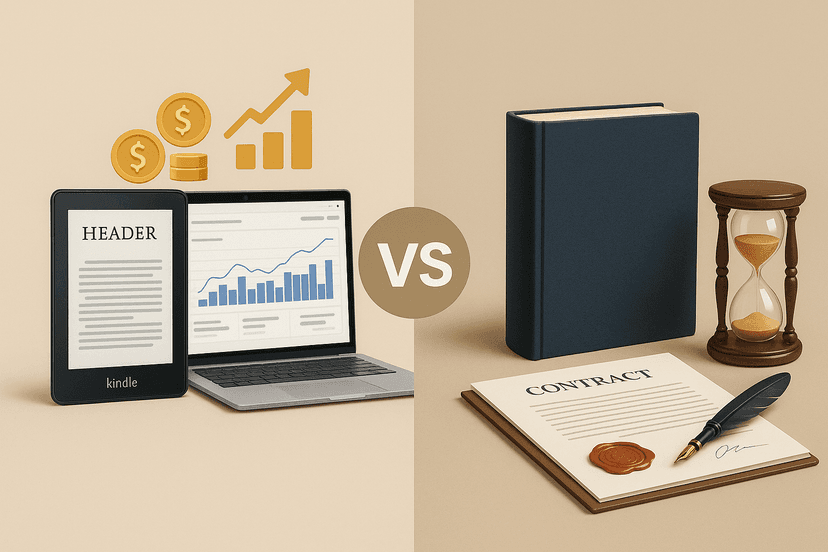
KDP vs Traditional Publishing: What’s Best for Authors?
Pros, cons, and opportunities of KDP vs. traditional publishers. Updated comparison with data from the Spanish market.
Leer más
Yoanys Pestana Alfonso
Co-Founder of Alavante, Editorial Design Specialist and UI/UX Designer.

An honest look at the KDP Select exclusivity model, KENP payouts, and whether the visibility is worth the trade-off.
Deciding whether to enroll your book in KDP Select (and thus Kindle Unlimited) is one of the first and most critical business decisions you will make as an indie author. It is not just a checkbox; it is a strategic choice between broad distribution and focused ecosystem dominance. Amazon requires 90 days of digital exclusivity. In exchange, you get access to millions of heavy readers.
The problem is clear: Do you bet everything on one platform to maximize visibility, or do you diversify your income streams from day one? For many, the answer lies in the math, not the sentiment.
Key Data: In 2026, Kindle ebooks still represent 83% of the US market, and KU subscribers read an average of 19 books per year. This volume is hard to replicate elsewhere.
You need to know if your specific genre and book length can monetize that volume effectively.
Value Preview: We will analyze the real value of a "page read" (KENP), why fiction authors have an unfair advantage, and the specific tools you need to track if you are losing money by staying exclusive.
Unlike selling a unit where you get a fixed royalty (35% or 70%), Kindle Unlimited pays you based on engagement. This is the Kindle Edition Normalized Page (KENP) system. A reader downloads your book for free, but you get paid only for the pages they actually read.
The Reality of the Payout The global fund fluctuates monthly. Historically, rates hover between $0.004 and $0.005 per page. This means a 300-page novel earns approximately $1.35 per full read. If your book is a short 50-page guide, you earn pennies. This model inherently penalizes brevity and rewards length and retention.
Exclusivity as Currency To access these readers, you must grant Amazon digital exclusivity via KDP Select. You cannot sell the ebook on Apple Books, Kobo, Google Play, or your own website. If you are caught, Amazon can ban your account. You are trading freedom for access to a customer base that reads 75% more than non-subscribers.
Not all books perform equally in this ecosystem. The algorithm favors consumption speed.
Fiction and Series (The Winners) Genres like Romance, Thriller, and Sci-Fi thrive here. Readers in these categories are "whales"—they consume a book a day. If you write series, KU is a goldmine. The "read-through" (readers moving from Book 1 to Book 2) generates compound income without additional marketing costs.
Non-Fiction and Textbooks (The Struggle) Reference books, cookbooks, or slow-burn literary fiction often struggle. Users dip in and out, resulting in low page counts. Unless your non-fiction has a strong narrative arc (like biographies or high-engagement self-help), the KENP model may yield lower returns than direct sales.
You cannot manage what you do not measure. Relying solely on the default KDP dashboard is insufficient for professional decision-making.
Many authors fail in KU not because the platform is bad, but because their strategy is flawed.
Are you sabotaging your own royalties?
| Common Error | Symptom | Solution |
|---|---|---|
| Ignoring Length | High downloads, low income ($0.30/book). | Bundle short stories into a collection to exceed 200+ KENP pages. |
| Poor Formatting | Readers stop at Chapter 1. | Use Vellum or Atticus to ensure clean breaks; "ghost" pages kill retention. |
| Passive Marketing | Zero page reads despite enrollment. | Run 5-day Free Promos to spike algorithm ranking, then switch to paid. |
| Breaching Exclusivity | "Cease and Desist" email from Amazon. | Remove digital files from ALL other platforms 24h before enrolling. |
Community Tip: Experienced authors often use the 90-day term to launch a book, gather reviews and reads, and then "go wide" (publish elsewhere) once the initial Amazon launch boost fades.
Kindle Unlimited is not a marriage; it is a 90-day renewable contract. It is the most powerful discovery engine for new authors with limited audiences, provided your book is long enough to generate significant KENP revenue.
Action Plan:
Do not guess. Let the data dictate your distribution strategy.
1 Automateed - Amazon Sales Stats 2 Universo Abierto - Kindle Statistics 3 Amazon KDP Help - KDP Select
Did you like this article? Share it and continue the discussion on your networks.
Pros, cons, and opportunities of KDP vs. traditional publishers. Updated comparison with data from the Spanish market.
Leer más
Checklist and tips for your manuscript, cover, and Amazon KDP publishing in 2025. Includes free tools.
Leer más
Discover how a landing page builds your brand, drives sales, and connects you with readers. Real example: Juan Gómez-Jurado’s website.
Leer más